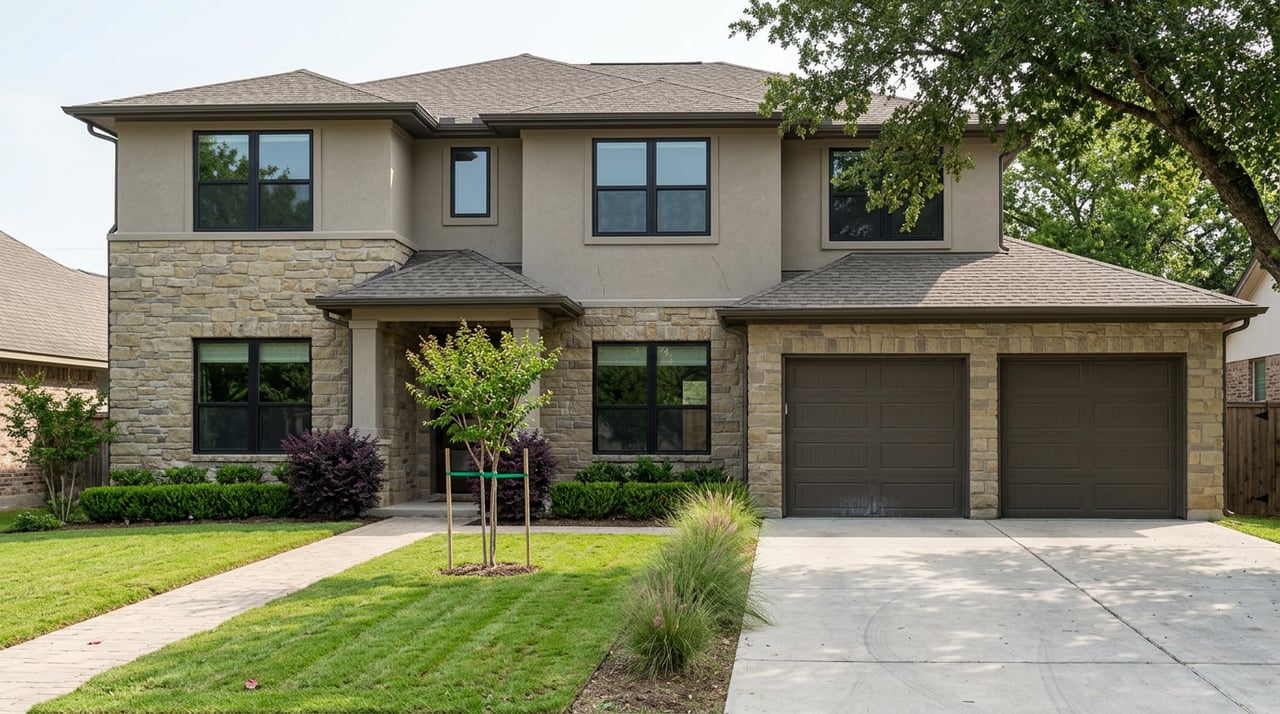
You're sitting at a builder's desk in a Frisco model home, and the number on the financing sheet looks fine. Home price at the top, loan terms in the middle, an estimated monthly payment at the bottom that fits the budget you walked in with. You sign. You close. You move your furniture in.
Then, a few months later, an escrow adjustment notice may arrive from your lender. The new monthly payment may be higher than the one you budgeted for at the model home desk, sometimes by a few hundred dollars. The disclosure is in your closing documents, but the number you signed for and the number you're now paying can differ; MUD and PID costs are among the factors to consider.
The financing sheet number is an estimate, not a final answer
The effect on a monthly payment depends on the property and the district's stage of development.
For a brand new MUD, the tax rate is set based on how many homes are expected to eventually share the bond debt, not how many are standing today. Until the district is closer to full build-out, lenders and builders often estimate using the current, partially built rate. As more homes get built and the district matures, the rate gets recalculated, and your escrow account gets adjusted to match.
A new MUD's tax rate is really a bet on how many rooftops will eventually share the debt. Buy early in a district's life, and you're financing infrastructure for homes that haven't been poured yet.
What a MUD pays for, and why the meter runs for decades
A Municipal Utility District is a special governmental entity that developers create to fund water lines, sewer systems, and drainage on land that didn't have city infrastructure when the community was platted. The district issues bonds to pay for that infrastructure, and homeowners inside the boundary repay those bonds through an added property tax line, on top of city, county, and school district taxes.
MUD rates can decrease as bonds get retired and as more rooftops join the tax base to share the debt, but that process commonly takes 20 to 40 years. If you buy in a young MUD, you should plan to carry that added tax line for most of the time you own the home, not just the first few years.
What a PID pays for, and why it doesn't move with your appraisal
A Public Improvement District works differently. Rather than an ad valorem tax that rises and falls with your home's appraised value, a PID is usually a fixed per-lot assessment set by the district's formation documents, often used to fund parks, streetscapes, and enhanced landscaping that the city wanted built without pulling from its general tax revenue.
Frisco's own Public Improvement District page lists a real example of how this looks on paper: a total assessment of $2,497.82 per lot, with some homeowners having paid the full amount at closing and others still paying it down over time. That structure means two neighbors in the same PID can be at very different points in the payoff, even though their annual obligation is set by the same formula.
Why the boundary line matters more than the floor plan
Frisco isn't one tax jurisdiction wearing one hat. The city's own property tax page notes that Prosper ISD, Lewisville ISD, and Little Elm ISD all have territory inside Frisco's city limits alongside Frisco ISD, and the city itself straddles both Collin and Denton counties. Add in the patchwork of MUDs and PIDs layered over specific subdivisions, and you get a situation where a home on one side of a street can carry a meaningfully different total tax load than a home on the other side, even at an identical list price.
Newer communities such as Phillips Creek Ranch and Hollyhock are commonly built with MUD and PID financing in place, which is standard for large master-planned developments built on land that needed new infrastructure. By contrast, marketing materials for communities including The Grove and sections of Fields and Lexington have been built and advertised with little to no MUD debt, which keeps their total tax rate noticeably lower.
| Community type | Typical district structure | Total tax rate pattern reported for this type of community |
|---|---|---|
| Heavy MUD/PID new construction, similar in structure to Phillips Creek Ranch and Hollyhock | MUD and/or PID layered on top of city, county, and school taxes | Reported as high as 2.2% to 2.5% in aggressive growth areas |
| The Grove, sections of Fields and Lexington (marketed as low or no MUD) | Minimal or no MUD debt | Marketed closer to 1.7% to 1.8% |
Treat this table as a starting point for a conversation, not a quote. Rates shift as districts mature, so the only number that matters for a specific address is the one on that lot's current county tax statement.
What the stack actually costs on a median Frisco home
Frisco's two largest fixed tax components are easy to verify directly. The city's fiscal year 2026 property tax rate is $0.425517 per $100 of assessed value, unchanged from the prior year, and Frisco ISD's 2025 adopted rate is $1.0194 per $100. Add county and community college rates on top, and area professionals commonly describe the base total, before any MUD or PID, as landing around 1.6% to 1.7% depending on which county line the home sits on and which exemptions apply.
Layer a MUD and PID on top of that base, and the combined rate on newer construction has been described as commonly running 2.2% to 2.5% in aggressive growth areas, meaning the special district alone can add roughly half a percentage point to a full percentage point on top of the base rate.
Here's why that spread matters in real dollars. As of the three months ending May 2026, the median sale price for a home in Frisco was $688,000. The difference between a 1.8% total tax rate and a 2.4% total tax rate on that same $688,000 home is 0.6 percentage points, which works out to roughly $4,128 a year, or about $344 a month. That's not a rounding error on a mortgage payment. It's close to a car payment.
Three documents to request before you sign anything
- The current tax statement for the exact lot, pulled from the Collin County or Denton County appraisal district, not a builder's estimate sheet. This shows every taxing entity actually billing that parcel today.
- The district's debt service schedule, which shows how much bond debt remains and gives you a realistic sense of whether the MUD rate is likely to hold, rise, or start declining during the years you plan to own the home.
- Written confirmation of how the PID is being collected, specifically whether it's a lump sum due at closing or an annual installment added to your tax bill for years to come.
A few questions worth settling early
Is a MUD tax the same as an HOA fee? No. An HOA fee is a private community due that funds amenities and common area upkeep. A MUD tax is a public, legally enforceable tax tied to the land itself under Texas Water Code Chapter 54.
Do MUD taxes ever disappear? They can decline as bonds are retired and the tax base grows, but that typically plays out over 20 to 40 years. Assume the tax line stays for as long as you own the home unless you've confirmed otherwise with the district's own debt schedule.
Can I negotiate my way out of a PID assessment? Review the assessment terms for the specific district.
The floor plan, the elevation, and the lot premium are the things a buyer notices first walking through a Frisco model home. The tax structure sitting underneath the community can also affect what you'll be paying five years from now. Pulling the real tax statement and the district's debt schedule before you sign is a small amount of homework that can help you understand the costs tied to a specific lot.
If you're comparing new-construction communities across Frisco, Prosper, or McKinney and want a second set of eyes on what a specific lot's tax structure actually looks like before you write an offer, the DiBella Team can help you pull the real numbers and read them in context. Your Path to Buying or Selling Starts Here.
This article is general information, not legal, tax or financial advice. Consult a qualified professional about your situation.