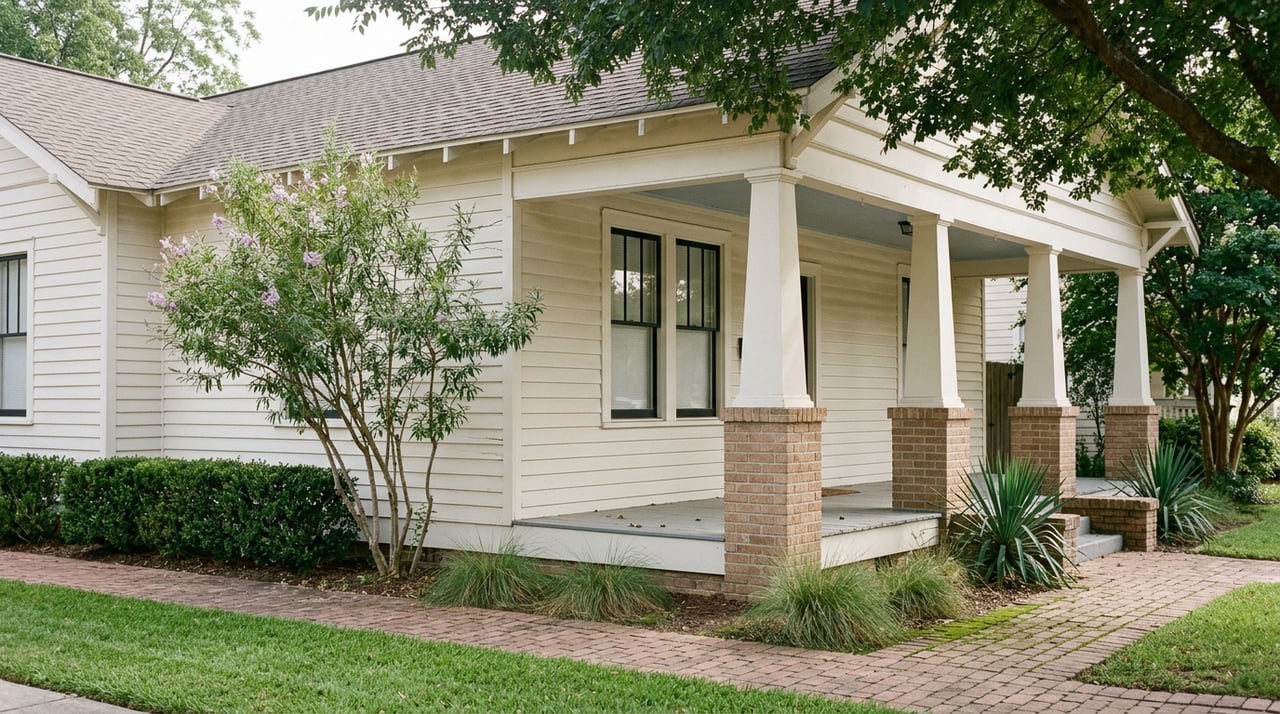
Say you close on a 1930s craftsman two blocks from the square, planning to bump out the kitchen and add a primary suite before you move a single box. The permit office tells you the addition is fine. What stops you is a Certificate of Appropriateness, a separate review the City of McKinney requires before any exterior change, redevelopment, or expansion on a property inside the Historic Overlay District. Your contractor can't pull the building permit until that certificate clears, and depending on the scope, that means either a staff-level sign-off or a slot on the Historic Preservation Advisory Board's monthly agenda, with applications due at least two weeks ahead of the meeting.
Nobody blindsided you. The rule has been public for years. But it's the kind of friction that only shows up once you own the house, and it points to something bigger than one renovation. In McKinney, the sticker price on a listing never tells you the whole story, because every part of this city is paying for its own growth somehow. The question worth asking before you write an offer isn't old versus new. It's which bill you're choosing to carry.
Three ways McKinney pays for growth
Walk from the historic core out toward Trinity Falls or Painted Tree and you're walking through three different funding models for the same basic problem: someone has to pay for the streets, water lines, parks, and design standards that make a neighborhood worth living in. Downtown pays with permission and a design review process. The newer MUD communities pay with a second, decades-long tax bill. The newest master-planned developments increasingly try to skip that tax bill entirely and fund everything through the homeowners association instead. None of these is a trick. Each is a legitimate, well-documented structure. But they land on a buyer's monthly budget in very different ways, and almost nobody explains all three side by side before the buyer is already under contract.
Downtown: the price is permission
The Historic Overlay District covers the residential blocks and commercial storefronts around the McKinney Square and Chestnut Square Historic Village, and the rules inside it are more specific than most buyers expect. A Certificate of Appropriateness is required before any new construction, redevelopment, reconstruction, expansion, alteration, relocation, or change in materials on anything visible from the public right of way. Ordinary maintenance and in-kind replacement, like swapping cedar shingles for matching cedar shingles, doesn't require one. Paint color, oddly, isn't regulated at all for residential properties, though the city does ask that owners avoid sandblasting old masonry when stripping paint. Commercial storefronts are a different story: those color changes do need approval.
Fences get their own line in the ordinance. Rear and interior side yard fences can run up to 6 feet 8 inches. Front yard fences top out at 4 feet and must be at least half transparent. Any new fence, or any change to an existing one's style, size, or location, needs both a Certificate of Appropriateness and a standard permit.
The upside is that the city also built in some financial offsets for this added review. Properties in the Historic Neighborhood Improvement Zone may qualify for exemptions on city ad valorem taxes. The Neighborhood Empowerment Zone waives impact fees for new residential or non-residential projects on vacant downtown parcels, provided the design follows the district's guidelines. Certain downtown properties can also draw on Tax Increment Reinvestment Zone funding. A homeowner who documents a house's history can apply through the Historic Preservation Advisory Board for a City of McKinney Historic Marker, and a marker can come with its own city property tax exemption.
As of July 2026, Historical McKinney's median home price sat at $698,500, with an average sale price of $710,895 and homes spending an average of 54 days on the market. Thirteen homes were listed at the time, ranging from $399,998 to $1,850,000, which tells you the district covers everything from a modest bungalow needing foundation work to a fully restored Victorian a few blocks from the square. What that range doesn't tell you is how much of the gap between list price and finished renovation comes down to how quickly a buyer's design plans clear the historic review process rather than how much the materials cost.
North of downtown: the price is a second tax bill
Trinity Falls, the Johnson Development community built out over roughly 1,702 acres with room for about 4,200 homes at full build-out, sits inside McKinney's extraterritorial jurisdiction rather than the city itself. That distinction matters more than most closing documents make clear. Because Trinity Falls falls within McKinney Municipal Utility District No. 1 and No. 2, its homeowners don't pay city of McKinney property taxes at all. Instead they pay MUD taxes, a separate ad valorem tax that funds the water, sewer, drainage, and road bonds the district issued to build the infrastructure in the first place.
The rates aren't hidden. The last publicly adopted rate for MUD 1 is $0.992525 per $100 of assessed value, split between maintenance and operations, water and sewer debt service, and road debt service. MUD 2's last adopted rate runs slightly higher at $1.05 per $100. Both districts publish updated budget figures each year and can lower the rate as bonds are retired, so a buyer should always confirm the current figure rather than assume last year's number still applies. On a $500,000 assessed home, that's roughly $4,963 a year in MUD 1 or $5,250 a year in MUD 2, a bill that shows up in addition to county and school taxes, not instead of them. The district's own materials are candid about the tradeoff: residents who choose to live inside a MUD are choosing to pay more than they would inside the city limits, in exchange for newer infrastructure and amenities built to a higher standard than the surrounding area might otherwise support. That MUD tax is treated as a property tax for federal purposes, meaning it's deductible if a buyer itemizes and stays under the state and local tax cap. It's a real cost, but not one that disappears from your return the way an HOA due does.
West of 75: the price is a quarterly invoice
Painted Tree, the roughly 1,100-acre master-planned community north of Highway 380 and west of Highway 75, takes a different approach. It's marketed explicitly as MUD and PID free, meaning residents skip that second ad valorem tax line altogether. Instead, the community's 200 acres of open space, its 20-acre stocked lake, its 25 miles of greenways and trails, and its pools are funded through a homeowners association charging $270 per quarter. Multiple builders, including Southgate Homes, Highland Homes, Trophy Signature Homes, and Coventry Homes, are building within the community, and new McKinney inventory across builder communities in this corridor has been advertised starting in the low $420s this summer.
The trade is straightforward once you see it: a much smaller annual number than a MUD tax bill, but one that buys governance by an HOA board rather than a taxing district, and one that isn't deductible on a federal return the way a MUD tax can be. You're not avoiding the cost of amenities. You're just paying for them through dues instead of a tax rate.
Here's the comparison side by side:
| Where | How you pay | What it funds | Rough annual cost signal | Deductible? |
|---|---|---|---|---|
| Historic Downtown | Design review time, occasional city fees | Preservation of historic character, streetscape | No MUD or PID; some tax exemption programs available | N/A |
| Trinity Falls (MUD 1/2) | Separate MUD ad valorem tax | Water, sewer, drainage, road bonds | ~$4,963 (MUD 1) to ~$5,250 (MUD 2) per year on a $500,000 home | Yes, as property tax, subject to SALT cap |
| Painted Tree | Quarterly HOA due | Trails, lake, pools, common area upkeep | ~$1,080 per year ($270/quarter) | No |
The lowest annual number on that table, Painted Tree's HOA due, is the one dollar figure that never touches your tax return. The largest, the MUD tax, is the one that at least partially does.
Before you write the offer
None of these structures should scare a buyer off a neighborhood they otherwise love. They should just get checked before the contract is signed, not after.
- If you're buying inside the Historic Overlay District and plan any exterior work, confirm with the city's Historic Preservation Office whether your specific property carries the overlay, and ask what level of review your planned changes would trigger before you assume a renovation timeline.
- If you're buying in a MUD community like Trinity Falls, pull the taxing entity list from the Collin County Appraisal District before you make an offer, not when the title company hands you a tax certificate at closing. The rate is public. There's no reason to learn it for the first time at the closing table.
- If you're buying in an HOA-funded community like Painted Tree, ask for the current HOA budget and reserve study, since a quarterly due that looks small today can move as amenities age and need replacement.
A few questions worth asking directly
Do sellers have to disclose historic designation when selling a McKinney home? Yes. Historic designation affects what a buyer can and can't do to the exterior, which makes it a material fact. It belongs on the Seller's Disclosure Notice, and it's worth confirming through your title company as part of the closing process.
Can I paint my historic home any color I want? For residential properties in the Historic Overlay District, yes, the ordinance doesn't regulate residential paint color. Commercial storefronts in the same district are a different matter and do require color approval.
Does a MUD tax ever go away? The tax exists to repay bonds, so the rate can decrease as that debt is paid down, and district boards have lowered rates before when they could. There's no fixed date attached to it, though. It runs on the district's own repayment schedule.
Every one of these paths, downtown's review process, Trinity Falls' MUD tax, Painted Tree's HOA structure, is a reasonable way to fund a growing city. The mistake is assuming one of them is free just because the fee doesn't show up on the same line as the sale price. If you're weighing a historic bungalow against a lot in Trinity Falls or a new build in Painted Tree, The DiBella Team can help you check the overlay map, the MUD rate, and the HOA budget before you write the offer, not after you've already committed to one of these three ways of paying for a place to live.